
People, places, and equipment
Dojo — the training hall or practice space.
Judogi — the judo uniform: jacket, trousers, and belt.
Judoka — a person who practices judo.
Obi — belt.
Sensei — teacher or instructor; commonly used for a judo coach.
Tatami — mats used for judo practice.
Tori — the person applying a technique.
Uke — the person receiving a technique.
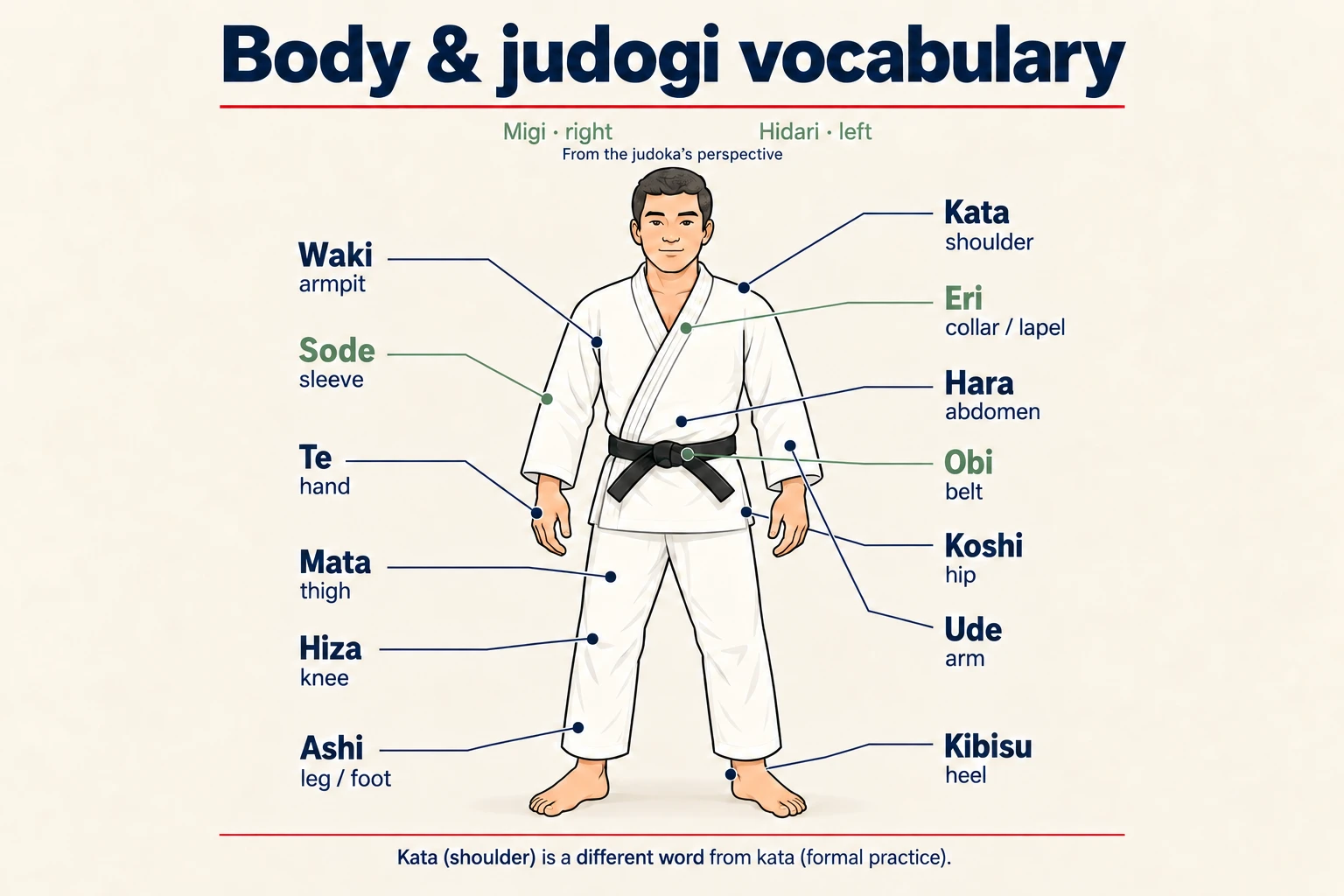
Practice and techniques
Ashi-waza — foot or leg techniques.
Kata — a formal, prearranged sequence used to study techniques and principles.
Katame-waza — grappling techniques.
Kime — completion or decisive focus; think of maintaining control through the finish of a technique.
Koshi-waza — hip techniques.
Kumi-kata — gripping; a basic grip includes lapel and sleeve.
Kuzushi — breaking or disturbing balance.
Nage-waza — throwing techniques.
Nagekomi — repeated practice of complete throws.
Ne-waza — groundwork.
Randori — free practice with a responding partner, used for learning and development.
Shiai — contest or competition.
Tachi-waza — standing techniques; the standing throwing groups include hand, hip, and foot/leg techniques.
Tai-sabaki — coordinated body movement and turning to adjust your position and direction. See foundational skills.
Te-waza — hand techniques.
Tsukuri — positioning or fitting the body for a technique.
Kake — execution of a technique.
Uchikomi — repeated entries into a technique without completing the throw.
Ukemi — receiving and breakfall skills.
Commands and scoring
Hajime — begin.
Ippon — a full, decisive score that ends the contest.
Kiotsuke — attention; used when assembling for a bowing ceremony.
Maitta — “I give up”; a verbal submission or stop signal.
Matte / mate — stop or wait; temporarily stops a contest or practice activity.
Rei — bow.
Sore-made / soremade — the end of the contest or practice round; not only a signal that the clock has expired.
Waza-ari — a score below ippon; two waza-ari combine to win the contest.
Yuko — a score below waza-ari. Yuko scores do not combine into waza-ari.
Shido — a penalty for a minor rule infringement; three shido result in hansoku-make.
Hansoku-make — disqualification from the contest, awarded directly for certain serious infringements or after three shido.
Osaekomi — the referee’s announcement that a qualifying hold-down has begun and is being timed.
Toketa — the referee’s announcement that the hold-down has ended; the contest may continue.
For scoring, penalties, and current rules, see Competition (Shiai).
Counting from one to ten
1 Ichi • 2 Ni • 3 San • 4 Shi • 5 Go • 6 Roku • 7 Shichi • 8 Hachi • 9 Kyu • 10 Ju.
You may also hear yon for four, nana for seven, and ku for nine. Long vowels and hyphenation are written differently across English-language references.
For a broader vocabulary reference, browse Lexicon Judo Terms (PDF), with Japanese terms and English meanings.
Learning resources
Class notes: Review techniques, themes, and supporting links from our classes. Open Class Notes.
Videos and books are useful for reviewing names, observing movement, and asking better questions. They complement supervised practice; they do not establish readiness to attempt an unfamiliar technique.
Club website, community and shared resources
Kokoro Judo website — club information, membership, and member login.
Free-trial and waiver page — share with prospective members.
Private Facebook group (members only) — a good place to stay in touch, share updates, and ask questions.
Public resource folder — educational materials, posters, and helpful documents to support your judo learning.
Recommended links, books and videos
Kodokan Judo book — a book for studying judo’s principles and techniques.
How to tie your belt — an instructional video on tying your belt.
How to breakfall — a video for reviewing ukemi and falling skills.
Judo competition — a video introduction to competitive judo.
Judo techniques — a playlist for reviewing judo techniques.
Kata — a book resource for studying formal practice.
Further reference
Kodokan technique names — the official technique list.
IJF technique library — classifications, demonstrations, and competition examples.
IJF mission and governance documents — background on judo’s educational mission and international organization.
IJF judo moral code — the eight values and their meaning.
IJF rules documents — open the most recent “IJF Sport and Organisation Rules (SOR)” version for competition and judogi requirements, and check any rules specific to your event.
USA Judo promotion resources — national rank guidance.
MyStudio member help guide — member app access and functions.
Using this guide
Return to this guide as your practice develops. Use the linked resources to deepen your understanding, and check current club guidance and event rules whenever requirements may have changed.
Learn at your pace. Take care of your partner. Help the club grow together.