
Foundational skills and the main technique families
Ukemi: receiving and breakfall skills. These are foundational safety skills, not scoring attacks.
Tai-sabaki: body movement and turning. Coordinating your steps, pivots, and body position helps you maintain balance, respond to your partner’s movement, and create an effective position for a technique. Alongside ukemi, it is a foundation for learning judo: move with control and use positioning rather than relying on strength alone.
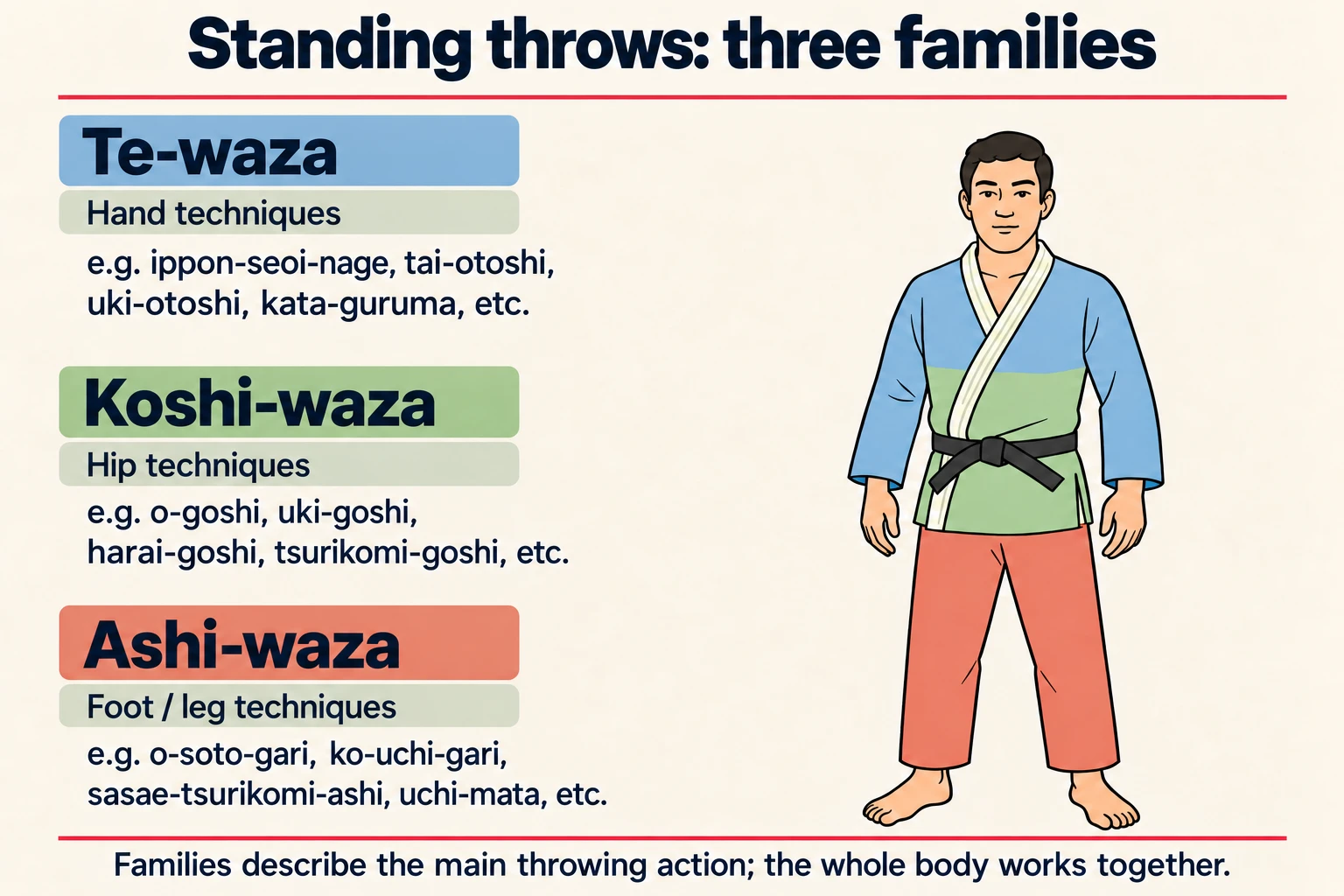
Nage-waza: throwing techniques. Tachi-waza includes standing hand techniques (te-waza), hip techniques (koshi-waza), and foot or leg techniques (ashi-waza). Sacrifice throws are grouped as sutemi-waza, including rear/supine and side sacrifice techniques.
Katame-waza: grappling techniques, including holds (osaekomi-waza), strangles (shime-waza), and joint locks (kansetsu-waza). Ne-waza means groundwork: it includes these techniques as well as ground movement, turnovers, and escapes. Put simply, katame-waza names a category of techniques; ne-waza describes the broader practice on the ground. Under current IJF competition rules, strangles and joint locks are generally restricted to ne-waza situations. This explains why the terms often overlap in everyday practice, even though their meanings differ. Beginners start with safe control, holds, and escapes before progressing to more advanced material.
Explore the broader repertoire in 100 Judo Techniques: Nage-Waza and Katame-Waza (PDF). For English meanings and foundational movement terms, use 100 Judo Techniques: Translation (PDF). These are reference catalogs, not a list of techniques permitted in every class or competition.
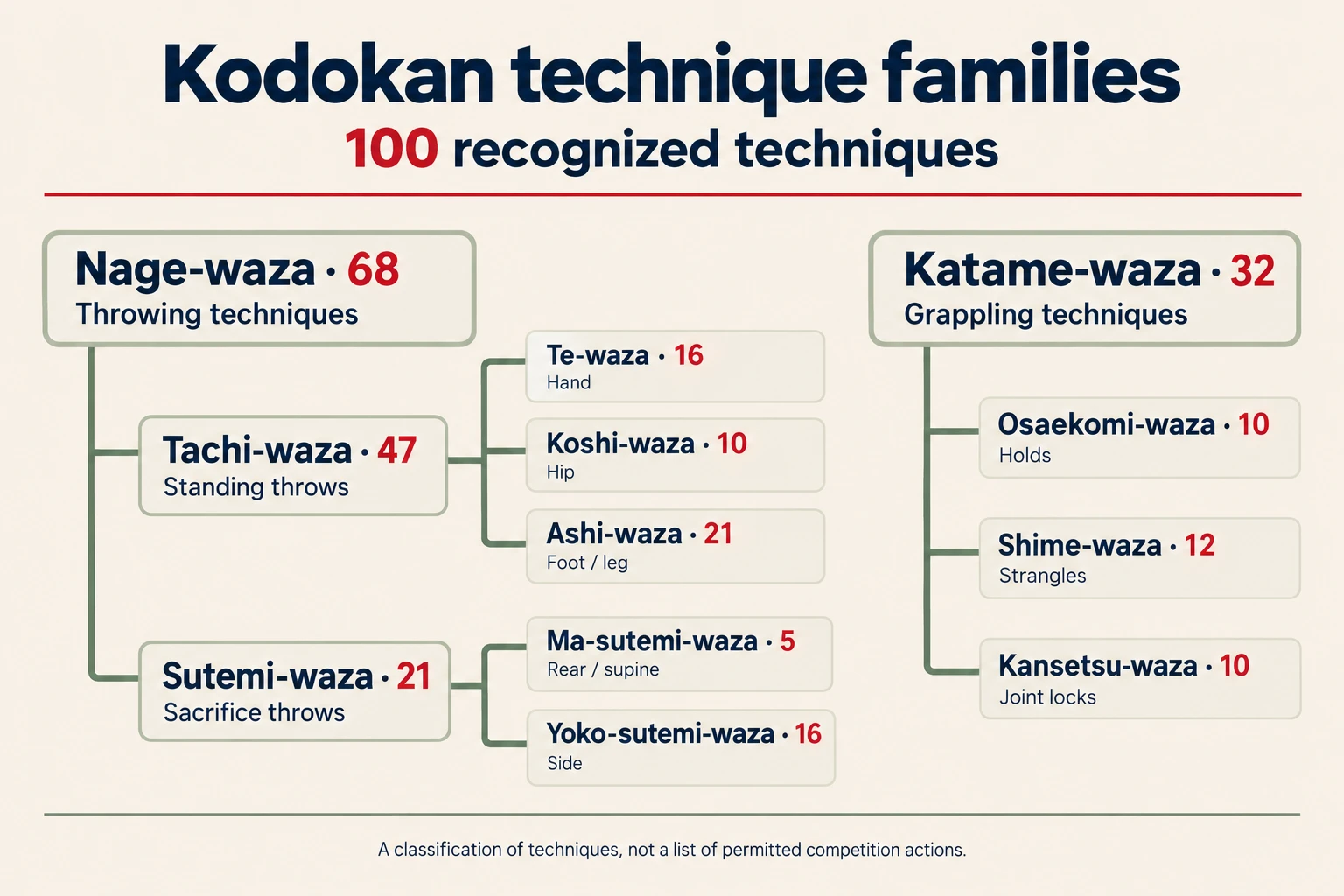
Examples you may encounter include O-goshi, a hip throw; O-soto-gari, a leg reap; and Ippon-seoi-nage, a hand-technique shoulder throw. Technique names are a shared vocabulary, not instructions to attempt unfamiliar throws without preparation.
Five parts of a controlled throw
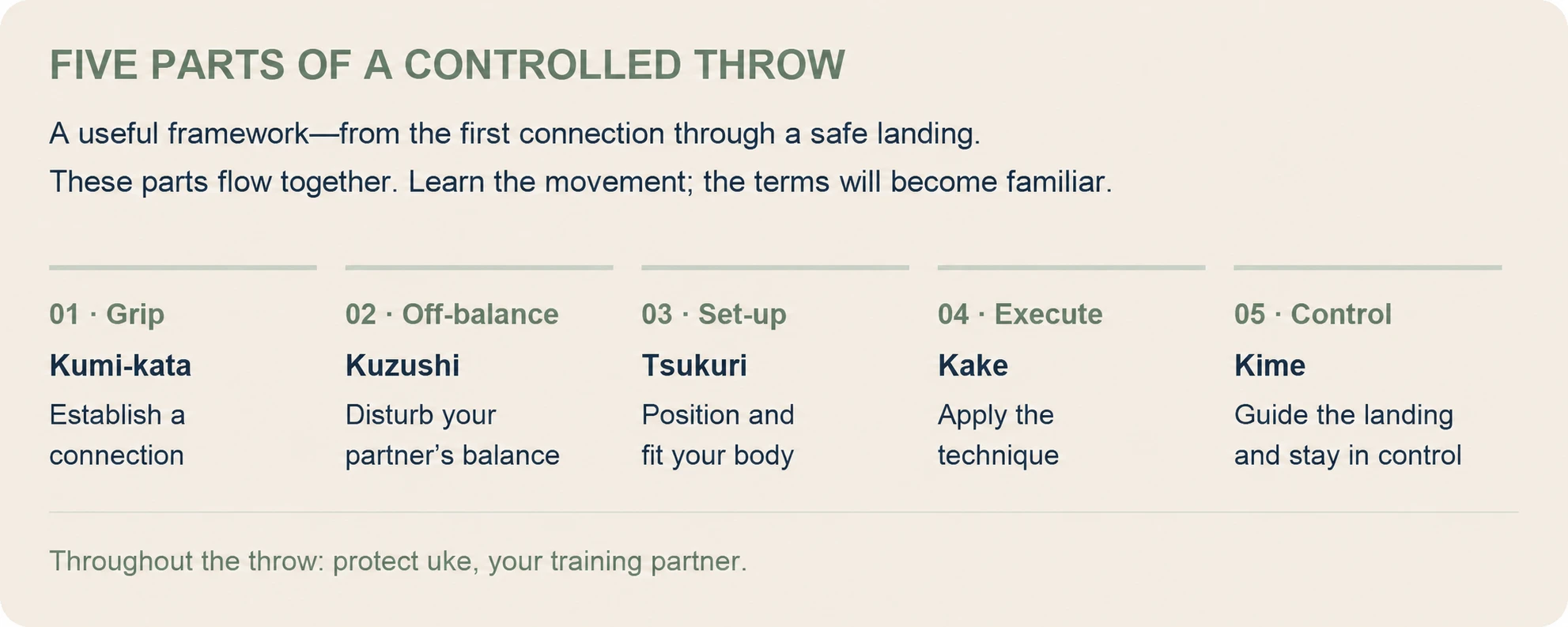
The phases flow together rather than behaving like five isolated pauses. In practice, a successful throw must protect uke. In competition, an ippon is a decisive score; throwing criteria include control and the quality of the landing, and ippon can also arise from permitted groundwork. Consult the event rules for the full criteria.
The Gokyo and the broader syllabus
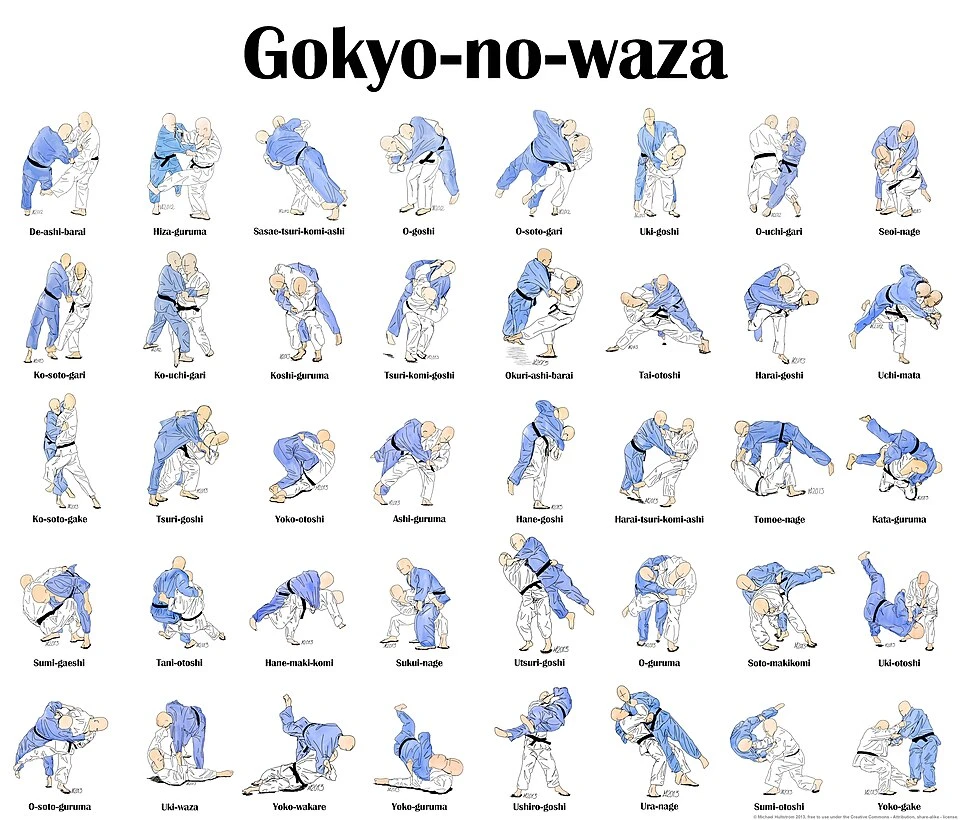
Kodokan judo recognizes 68 throwing techniques. The Gokyo-no-waza is a traditional selection of 40 throws arranged in five groups of eight. It is an important study framework, rather than a promise that everyone learns every throw in the same order or a substitute for the club’s current promotion requirements.
Use the five groups below as a reference when studying the Gokyo. Spellings and hyphenation vary between references.
Group 1: De-ashi-harai, Hiza-guruma, Sasae-tsurikomi-ashi, Uki-goshi, O-soto-gari, O-goshi, O-uchi-gari, Seoi-nage.
Group 2: Ko-soto-gari, Ko-uchi-gari, Koshi-guruma, Tsurikomi-goshi, Okuri-ashi-harai, Tai-otoshi, Harai-goshi, Uchi-mata.
Group 3: Ko-soto-gake, Tsuri-goshi, Yoko-otoshi, Ashi-guruma, Hane-goshi, Harai-tsurikomi-ashi, Tomoe-nage, Kata-guruma.
Group 4: Sumi-gaeshi, Tani-otoshi, Hane-makikomi, Sukui-nage, Utsuri-goshi, O-guruma, Soto-makikomi, Uki-otoshi.
Group 5: O-soto-guruma, Uki-waza, Yoko-wakare, Yoko-guruma, Ushiro-goshi, Ura-nage, Sumi-otoshi, Yoko-gake.
Official technique references & demonstrations
Start here when reviewing a technique. Use these official Kodokan and IJF resources as your primary references for technique names, classifications, and demonstrations.

Kodokan technique names
Review official names and classifications across judo’s technique families.
Explore the Kodokan reference ↗
IJF technique library
Explore technique demonstrations to support your review between classes.
Watch and explore techniques ↗Recognition in the judo syllabus does not mean a technique is permitted in every competition or appropriate for every practice group. Review demonstrations alongside your sensei’s guidance.
For another way to study these principles, explore kata and structured partner practice.