
A different way to study judo
Kata is a formal, prearranged practice of techniques and principles. It offers a different way to study precision, cooperation, and the reasons a technique works. Competition, or shiai, is another part of judo; members may enjoy judo recreationally as well as competitively.
Randori-no-kata: a shared teaching framework
Randori-no-kata is the collective name for nage-no-kata and katame-no-kata. Together, these two complementary forms study principles that underpin free practice (randori): how a technique is prepared, why it works, and how partners move and respond.
Think of them as a shared teaching framework. A defined sequence and clear roles give teachers and students a common reference, helping judo’s knowledge be taught consistently, passed on, and developed across dojos and generations. Standardizing the forms preserves a foundation for learning while leaving room to deepen understanding through practice.
- Nage-no-kata — forms of throwing: studies balance, positioning, timing, and the execution of throws.
- Katame-no-kata — forms of grappling: studies holds, strangles, and joint locks, including the relationship between control and uke’s responses.
Kata and randori support one another: kata makes principles easier to observe in a structured setting; randori asks you to recognize and apply them in changing situations. Randori-no-kata is therefore a foundation for ongoing practice, not only a sequence to learn for grading or competition.
Read more in the IJF’s The Need to Study Kata and introduction to kata.
Learning together
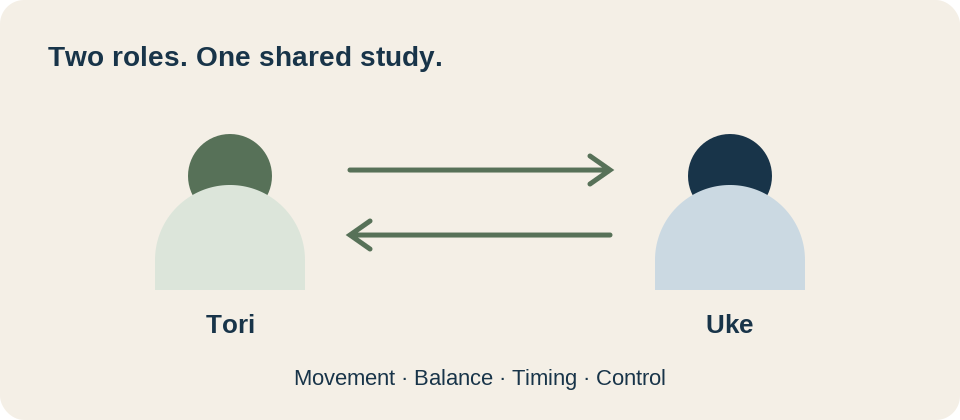
Kata offers a structured setting to study precision, cooperation, and why a technique works. Tori and uke both contribute to the practice: one applies the technique and the other receives it, with attention to movement, balance, timing, and control.
Use the same habits of communication and partner care that guide the rest of your practice. Work at a pace appropriate to your experience and readiness.
Studying nage-no-kata
When studying nage-no-kata, see Nage-No-Kata: Starting Positions (PDF), a visual reference for the right-side sequence and partner positioning.
- Nage-no-kata: Memory Path (PDF) — an optional mnemonic aid for reviewing the sequence.
- Nage-no-kata: Practice Notes — May 2025 (PDF) — supplementary coaching notes for review and discussion with a sensei; not an official kata standard.
Studying katame-no-kata
Katame-no-kata is a formal study of grappling and control. Its fifteen techniques are arranged in three groups: holds (osaekomi-waza), strangles (shime-waza), and joint locks (kansetsu-waza). Both partners study how control is established and how uke responds, with careful attention to timing and release.
Katame-no-kata: Starting Positions (PDF) — draft reference for partner positioning. Use it alongside a sensei’s guidance; details may be revised.
Browse the Techniques & Kata resource folder for additional practice material. For background, see the IJF introduction to katame-no-kata.
Kata resources
Kata — a book resource for studying formal practice.
These resources complement practice. Use them to review, observe, and prepare questions.